
How to Choose Your First Car in India: A Step-by-Step Guide
Buying your first car in India? Follow this step-by-step guide to set a budget, pick the right type, and avoid common first-time mistakes.
Buying your first car is exciting, but it is also one of the largest purchases most families make. A little planning at the start saves a lot of money and regret later. This guide walks you through the decision in the order that actually matters.
Step 1: Set a realistic total budget
Do not stop at the showroom price. The cost of owning a car includes the on-road price (ex-showroom price plus registration, road tax and insurance), fuel or charging, servicing, tyres, parking and the loan interest if you borrow. A common rule of thumb is to keep the monthly EMI plus fuel and upkeep within roughly a fifth to a quarter of your take-home income. Our guide to calculating your true monthly running cost shows how to do this properly.
Step 2: Be honest about how you will use the car
- Mostly city driving, short trips: a compact hatchback, a petrol with an automatic, or an electric car with home charging.
- Daily long commute (60+ km a day): running cost matters most, so look at efficient petrol, CNG, hybrid or electric options.
- Family of four or five, occasional highway trips: a compact SUV or a sedan with enough boot space and power.
- Rough roads or monsoon flooding: higher ground clearance helps.
Step 3: Choose a body type
| Body type | Good for | Watch out for |
|---|---|---|
| Hatchback | City use, easy parking, lower cost | Limited rear space and boot |
| Compact sedan | Comfort, large boot | Lower ground clearance |
| Compact SUV | Ground clearance, upright seating | Higher price and often lower efficiency |
| MPV | Large families, lots of luggage | Size in tight city streets |
Step 4: Decide the fuel type
Petrol, diesel, CNG, hybrid and electric all make sense for different drivers. We compare them in detail in Petrol vs Diesel vs CNG vs Electric. If you are unsure, work out the cost per kilometre for your own driving rather than trusting general claims.
Step 5: Put safety first
Look for a strong crash-test rating, at least two airbags (more is better), electronic stability control, ABS with EBD and ISOFIX child-seat mounts. Safety features are cheaper to buy at the start than to wish for after an accident. Read how to read NCAP safety ratings before you shortlist.
Step 6: Shortlist three cars, then compare
Pick three models that fit your budget and needs. Compare them on safety, real-world mileage, space, service network in your town, spare-part availability and expected resale value. Our article on reading a car brochure helps you cut through marketing numbers.
Step 7: Test drive and choose the variant
Always test drive your shortlisted cars on roads you actually use. Use our test drive checklist. Then decide which trim to buy using the advice in how to pick the right variant.
Step 8: Sort out finance and insurance
Compare loan offers from banks as well as the dealer, and understand how EMI and interest work. For insurance, read our insurance guide and do not choose purely on the lowest premium.
Common first-time mistakes
- Buying the biggest car the budget allows, then struggling with running costs.
- Paying for features you will not use while skipping safety features.
- Ignoring the service centre distance from home.
- Skipping the test drive or doing it only around the showroom block.
- Not asking for the full on-road price in writing.
Frequently asked questions
Should my first car be new or used?
Both can work. A new car gives you a warranty and peace of mind; a used one costs less and loses value more slowly. See New vs Used: which makes more financial sense.
Is an automatic a good first car?
If you drive in heavy traffic, yes. Learn the differences in our gearbox explainer.
How much down payment should I make?
A larger down payment reduces your EMI and total interest. Many buyers aim for around 20 percent of the on-road price, but choose a figure you can afford without draining your emergency savings.
This article is general information and not financial advice. Prices, taxes and rules change, so confirm current figures with the dealer and official sources.

Related articles
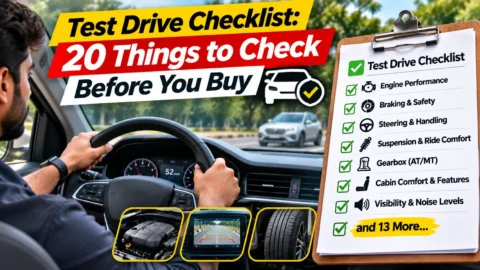
Test Drive Checklist: 20 Things to Check Before You Buy
Make your test drive count. Use this 20-point checklist to evaluate comfort, visibility, brakes, noise and more before you buy a car.
Base, Mid or Top Variant: How to Pick the Right One
Not sure whether to buy the base, mid or top variant? Learn which features are worth paying for and which you can…
How to Read a Car Brochure: The Specs That Actually Matter
Learn which numbers in a car brochure really matter, from torque and ground clearance to airbags and warranty, and which are just…
0 comments