
Car Loan Basics: EMI, Interest Rate and Down Payment Explained
Understand how car loans work in India, including EMI calculation, interest, down payment, tenure and fees, with a worked example.
Most car buyers take a loan. Understanding how it works can save you tens of thousands of rupees. Here are the basics.
Key terms
- Principal: the amount you borrow.
- Interest rate: the yearly cost of borrowing, charged on the outstanding balance.
- Tenure: the repayment period, in months or years.
- EMI (equated monthly instalment): the fixed monthly payment of principal plus interest.
- Down payment: the part of the price you pay upfront, which reduces the loan.
The EMI formula
EMI = P x r x (1 + r)^n / ((1 + r)^n – 1), where P is the principal, r is the monthly interest rate (annual rate divided by 12 and by 100) and n is the number of months. Banks and online calculators do this for you, but it helps to understand it.
Worked example (illustrative)
Suppose you borrow Rs 8,00,000 at 9 percent a year.
| Tenure | Approx. EMI | Total interest paid |
|---|---|---|
| 4 years (48 months) | about Rs 19,900 | about Rs 1,55,600 |
| 5 years (60 months) | about Rs 16,600 | about Rs 1,96,400 |
A longer tenure lowers the EMI but increases total interest. These are example figures; your actual rate depends on the lender, your credit profile and the car.
What affects your interest rate
- Your credit score and credit history.
- Income and employment stability.
- Loan amount relative to the car’s price.
- Tenure and whether the car is new or used.
- The lender’s current policies.
Costs beyond the interest rate
- Processing fee: charged by the lender.
- Prepayment or foreclosure charges: check what applies if you repay early.
- Documentation and other charges: ask for the full list in writing.
- Insurance bundling: check if the dealer is adding costly extras into the loan.
Tips for a better loan
- Check and improve your credit score before applying.
- Compare offers from several banks and non-bank lenders, as well as the dealer.
- Make the largest down payment you can afford.
- Choose the shortest tenure you can manage comfortably.
- Read the loan agreement fully, including penalties.
- Check whether the interest rate is fixed or floating, and how it is calculated.
How much can you afford?
A common guide is to keep the EMI plus fuel and upkeep at a modest share of your take-home income. Use our running-cost calculation to include everything. If you are buying your first car, see how to choose your first car.
Loan and the car’s paperwork
The lender’s name is added to the RC as hypothecation until the loan is repaid. When you close the loan, you must get the paperwork to remove it. See documents needed to buy or sell a car.
Frequently asked questions
New vs used car loan rates?
Used-car loans often carry higher rates. See new vs used.
Can I repay early?
Often yes, but check the charges. This is general information, not financial advice. Confirm terms with your lender.

Related articles

Documents Needed to Buy or Sell a Car in India
A practical checklist of the documents and forms needed to buy or sell a car in India, including RC transfer, insurance and…
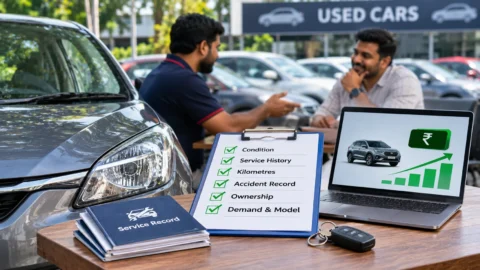
Car Resale Value: What Affects It and How to Get a Better Price
What decides your car's resale value, and how can you get a better price? Learn the key factors and a step-by-step plan…
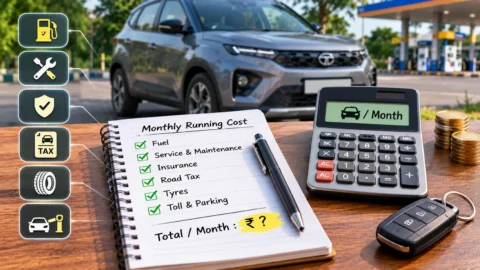
How to Calculate Your Car’s True Monthly Running Cost
Find out what your car really costs each month. Use this simple framework covering fuel, EMI, insurance, servicing, tyres and depreciation.
0 comments