
How to Read a Car Brochure: The Specs That Actually Matter
Learn which numbers in a car brochure really matter, from torque and ground clearance to airbags and warranty, and which are just marketing.
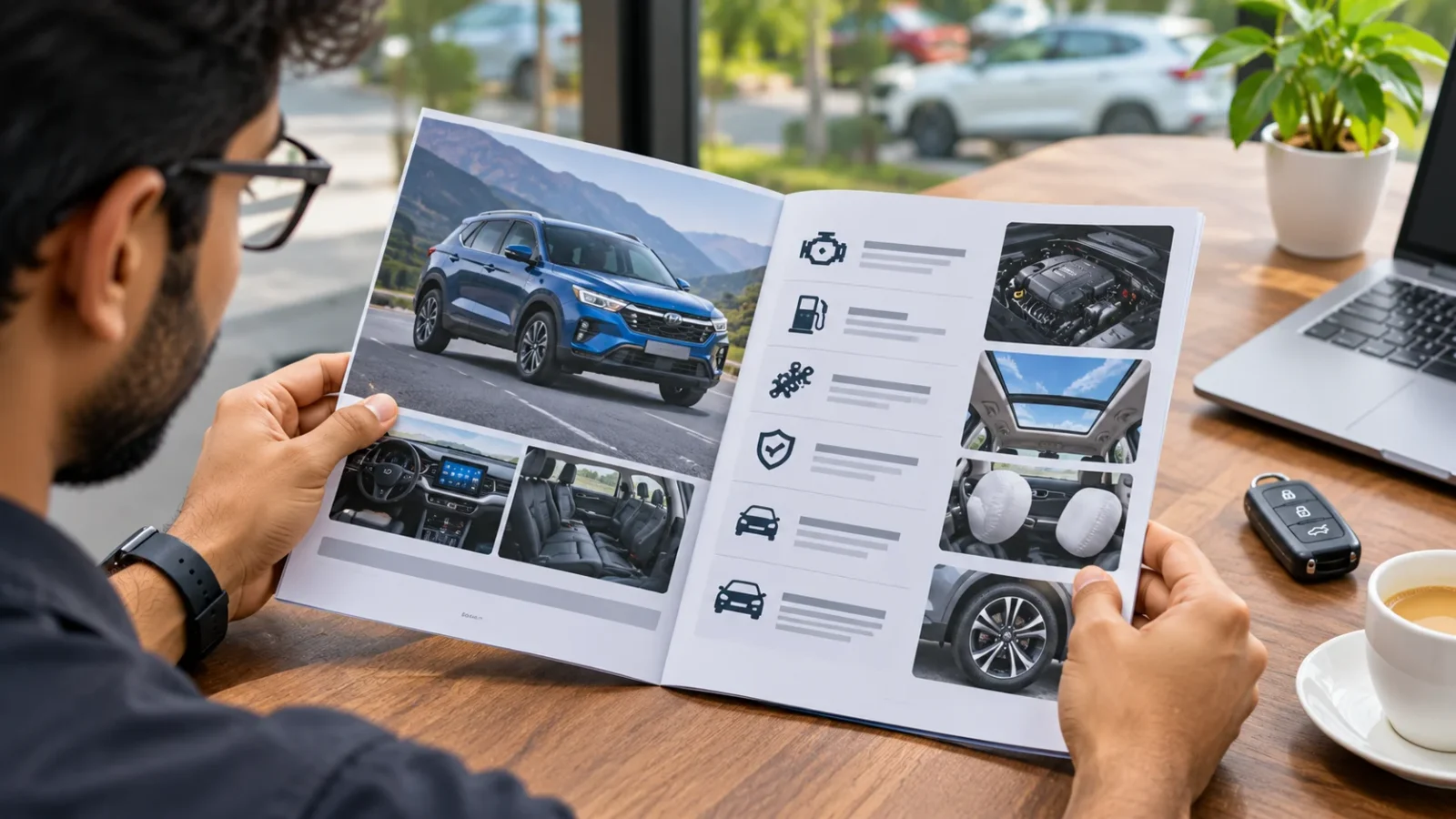
How to Read a Car Brochure:- A car brochure packs in dozens of numbers. Some tell you a lot about how the car will feel and what it will cost to own; others are mostly marketing. Here is how to read the important ones.
Engine and performance
- Displacement (cc): engine size. Bigger is not always better, as modern turbo engines make good power from small displacement.
- Power (bhp, PS or kW): useful for top-end and highway pace.
- Torque (Nm) and the rpm it arrives at: torque available at low rpm makes a car feel responsive in city traffic. A car that makes peak torque low in the rev range feels easier to drive.
- Power-to-weight ratio: compare power with kerb weight. A lighter car with the same power feels quicker.
Mileage figures
The claimed (ARAI) fuel economy is measured under laboratory conditions. Real-world figures are usually lower, especially with air conditioning and traffic. Treat the claimed number as a way to compare cars with each other, not as what you will get. For tips on improving yours, see 12 ways to improve your car’s mileage. For electric cars, the claimed range is also an ideal figure; see how to get more range from your EV.
Dimensions and space
- Length and wheelbase: a longer wheelbase usually means more rear legroom.
- Ground clearance: important on broken roads and during monsoon flooding. Check whether the figure is for an unladen car.
- Boot space in litres: check it in person with your luggage.
- Fuel tank size: multiplied by real-world mileage tells you your range between fill-ups.
Safety
This is the section to read most carefully. Look for the number of airbags, electronic stability control, ABS with EBD, rear parking sensors, ISOFIX anchors and the crash-test rating. See how to read NCAP safety ratings.
Suspension, brakes and tyres
Disc brakes at the front are standard; rear discs or drums matter less in everyday use. Tyre size affects ride comfort and replacement cost: bigger low-profile tyres look good but ride harder and cost more to replace. Read our tyre care guide to understand ongoing costs.
Warranty and service
Look at the standard warranty period and kilometre limit, what is covered, the service interval and the cost of the first few services. For electric cars check the battery warranty terms. See EV battery life and warranty.
Marketing numbers you can mostly ignore
- 0-100 km/h times unless you care about performance.
- Count of “connected features” that you will not use.
- Screen size as a measure of quality, as software speed matters more.
A quick comparison template
Put your shortlist into a small table with these rows: price, engine and torque, real-world mileage from owner reports, safety rating, airbags, ground clearance, boot space, warranty and service cost. Then judge them on the points that matter to your use. Our first car guide shows how to build the shortlist.
Frequently asked questions
Is more power always better?
No. A car that is easy to drive at low speed often suits Indian traffic better than a high-power but peaky one.
Where can I find real-world mileage?
Look at owner forums and independent road tests, and compare multiple sources.

Related articles
Test Drive Checklist: 20 Things to Check Before You Buy
Make your test drive count. Use this 20-point checklist to evaluate comfort, visibility, brakes, noise and more before you buy a car.

Base, Mid or Top Variant: How to Pick the Right One
Not sure whether to buy the base, mid or top variant? Learn which features are worth paying for and which you can…
How to Choose Your First Car in India: A Step-by-Step Guide
Buying your first car in India? Follow this step-by-step guide to set a budget, pick the right type, and avoid common first-time…
0 comments