
Manual vs AMT vs CVT vs DCT vs Torque Converter: Explained Simply
Confused by AMT, CVT, DCT and torque converter? This plain-English guide explains how each gearbox works and who should buy which.
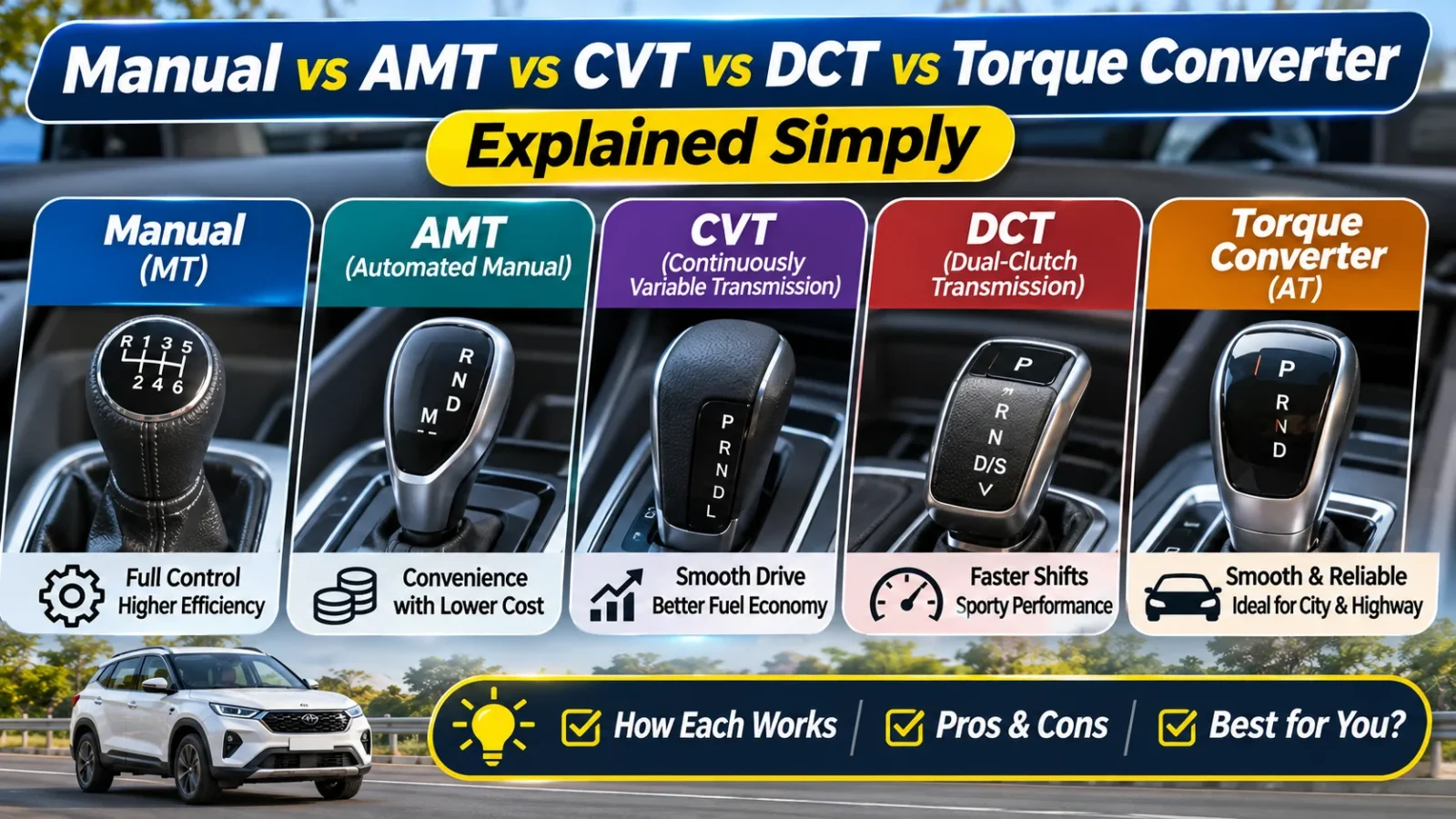
Walk into a showroom today and you will hear a string of confusing terms: AMT, CVT, DCT, iMT, torque converter. They all try to take the work out of changing gears, but they behave quite differently. Here is what each one does and who it suits.
Manual
You press the clutch and change gears yourself. Manuals are usually the cheapest to buy and repair, give you the most control and are often the most fuel efficient. The downside is effort in stop-and-go traffic.
AMT (Automated Manual Transmission)
An AMT is a manual gearbox with a computer and actuators that press the clutch and change gears for you. It is the most affordable automatic. The trade-offs are noticeable pauses and head-nodding during gear changes, especially in older designs, and less refinement. It suits budget buyers who mostly drive in the city.
CVT (Continuously Variable Transmission)
A CVT uses a belt (or chain) between two cones, so it has no fixed gears. It delivers very smooth acceleration and good efficiency in city use. Some drivers dislike the “rubber-band” engine sound when accelerating hard. CVTs suit relaxed drivers who value smoothness.
DCT (Dual-Clutch Transmission)
A DCT has two clutches handling odd and even gears, so the next gear is pre-selected and changes are very quick. It feels sporty and efficient on the highway. In heavy stop-and-go traffic, some dry-clutch units can feel jerky at low speed and may need careful use and good servicing.
Torque converter automatic
This is the traditional automatic, using a fluid coupling and planetary gears. It is smooth, durable and well suited to Indian traffic, though it can be slightly less efficient and costs more. It is common in larger and more premium cars.
Comparison
| Type | Smoothness | Cost | Best for |
|---|---|---|---|
| Manual | Depends on you | Lowest | Control and low cost |
| AMT | Fair | Low | Budget city driving |
| CVT | Very smooth | Moderate | Relaxed city and mixed use |
| DCT | Quick shifts, can be jerky in traffic | Higher | Enthusiastic driving |
| Torque converter | Smooth and robust | Higher | Comfort and durability |
Electric and hybrid cars
Most electric cars use a single-speed gearbox, so there is nothing to shift. Many hybrids use an e-CVT, which behaves differently from a belt CVT. See how electric cars work.
How to choose
- Take a long test drive in traffic with each type. Use our test drive checklist.
- Check the manufacturer’s service guidance for the gearbox, especially fluid changes.
- Consider resale: demand for automatics in your city affects your resale value.
Frequently asked questions
Which automatic is the most reliable?
Reliability depends more on the specific model, quality of servicing and driving style than on the type alone. Check owner feedback for the exact car you are considering.
Do automatics give worse mileage?
Modern automatics can be close to manuals; some are even better in the city. Always compare the real-world figures.

Related articles
Test Drive Checklist: 20 Things to Check Before You Buy
Make your test drive count. Use this 20-point checklist to evaluate comfort, visibility, brakes, noise and more before you buy a car.
Base, Mid or Top Variant: How to Pick the Right One
Not sure whether to buy the base, mid or top variant? Learn which features are worth paying for and which you can…
How to Read a Car Brochure: The Specs That Actually Matter
Learn which numbers in a car brochure really matter, from torque and ground clearance to airbags and warranty, and which are just…
0 comments